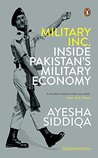
 Military Inc.: Inside Pakistan's Military Economy by Ayesha Siddiqa
My rating: 4 of 5 stars
The last line of the 2017 edition epilogue is "The soft martial law is here to stay". I couldn't agree more.
In terms of a good leader, Pakistan has been out of luck after Jinnah. Founding father wanted a moderate, liberal and progressive country for Muslims of sub-continent and also for minorities as well. But that didn't suit us. We, the authoritarian and feudal type illiterate and ignorant people, couldn't stand any of those principles. That's exactly what happened after Jinnah, just stay with me. Jinnah left us in 1948 when Pakistan was just one year old. An infant soon to be spoiled and exploited by every thug and lout whether in uniform or not but that comes later. Oh my country I feel sorry for you and all the people who sacrificed for you. So the so-called civilian leaders/bureaucrats started a power struggle and in between forgot to make a constitution till 1956. Just some lousy 1949 resolution based on 1935. They couldn't even decide who was to lead so there were six prime ministers from 1951-1957 and then the martial law was imposed. While the public just watched in awe what was happening still having faith in their great country for which they fought and struggled so hard. But they are just public who cares about them. Only the elite. Iskander Mirza, the then President who imposed Martial Law, hoped that his friend General Ayub will stand by him and together they will lead the country with one string each. Either he was so stupid that he didn't understand what attraction the 'power' has or more stupid to trust on such a friend. And then the General threw the friend out of the club and took over the country. Now military started building institutional strength and systematic importance in the country. Stint in Kashmir in 1965 which led to a war but we didn't stop there. We did same in 1999 but that comes later.
From its inception, Pak Army has managed to sell the rhetoric of 'A National Savior' in external and internal matters. Now there was political vacuum provided by incompetency of politicians cum bureaucrats after Jinnah's demise and Army was there to save the country but not to serve the country rather to serve itself. Gen Ayub did introduce some famous land reforms but they were just a sham. How could he anger the power land feudal class by introducing land reforms which were introduced in India in 50s. I wouldn't if I wanted to stay in power. So they say"but if you want to test a man's character, give him power" dont know whether it is relevant or not but who cares.
So after the war General became Field Marshal and president. I forgot to mention 1962 presidential constitution as the 1956 one was cancelled or whatever in 1958. So now the president field marshal has everything except control over fate and time. Both are strange and funny. At that time 22 families owned a huge chunk of country assets lets say 70%. The economy was growing so was the inequality and then there were some custom officials' mishandling of the students which led to protests and death of one student. Army had to save its face by changing the facade. Finally Ayub Khan left office and also left Yahya Khan in the office who was famous for interesting things. Up till now Fauji Foundation, AWT and FWO were already up and running. Military was gaining strength politically and economically. Hopes were high for good things to come for some. Then 1971 came with a lot of action. General Elections were held and Awami League won which was unacceptable for West Pakistani leaders especially Ayub Khan's protege Zulfiqar Ali Bhutto. He lobbied for no power transfer to Mujib-ur-Rehman, leader of Awami League. The General Assembly session to be held in Dhaka kept on getting delayed. People in East Pakistan, already aware of their lowly treatment by West Pakistanis, started coming on streets demandinig for independence if not for transfer of power. Yahya ordered army to strike and things go messy which made the EPs even stronger. India took advantage of the situation and our great Army had to surrender with 90000 military personnel. Bad time for Army. Bad time for Pakistan as it losts it Eastern Wing.
Finally it was realized that it was better to transfer the power to civilian government. Zulfiqar Bhutto's hunger for power was satisfied.New constitution came in 1973 which has survived till now with 25 amendments. He started a populist movement with 'roti kapra and makaan' as its slogan. Poor people liked him for his socialist thought. He nationalized all the great companies. Making people unhappy. Tried to bring military under civilian government. Making more people, now in uniform, unhappy. The time was relatively better for development of democracy but who wants that. So in 1977 Gen Zia declared Martial Law and put a stop to Bhutto and his politics and ultimately his life. The same year Shaheen Foundation was also established by PAF being not satisfied by the Fauji Foundation. Bahria Foundation was established in 1982. Both were established under Charitable Endowment Act 1890 which makes them free from any accountability. So the MILBUS was flourishing. Also after the completion of Korakoram Highway in 1979, FWO remained, to be used in case of emergency. National Logistics Cell was established in 1978. Not going in detail about all these organizations. It would be better to read the book as the author has done excellent research especially looking at the power of the organizations. No wonder she is called traitor. The so-called traitors. Author needs not to worry as she has joined an elite intellectual club of people who speak against authority and suffer just for the betterment of the society. History is full of examples.
So coming back to Zia. It was a time of so called Jihad we were fighting on behalf of Americans who were showering money and wepons on us in response. The dictator utilized the Afghan War fully for his political advantage. Mullahs and their parties were standing with him and so were the Americans who are supposed to promote democracy at all times. Eighth Amendment was passed in 1985 which gave the President unilateral power to dissolve the National Assembly. Zia died in mysterious air crash in 1988. He couldn't use the power of aforementioned amendment when it became very popular in 90s.
Zia gave birth to PML(N) and MQM to counter PPP. Military was infiltrating in all parts of the state. Zia's successor Gen Aslam Beg decided to let the civilians run the show for now. The next ten years was clown show resulting from the power Military had gained and the eighth amendment. First came PPP in 88, then PML (N) in 91, then PPP again in 93, then again PML (N) in 96 and then again dictatorship in 99. Great. Back to where started.
1999 was a tough year due to Kargil issue. Nawaz Sharif was angry at Gen Musharraf, then COAS, for not letting him in on Kargil Plan. He wanted to appoint a new chief. Actually he had appointed once Musharraf was away on a visit in Sri Lanka. So coup was what happened in the end. You can read the whole story at many places.
So military in power again. This time they will make sure that they have a say in strategic and important decisions if they ever want to hand over the govt back to civilians. Musharraf started NAB to counter politicians not corruption. He established National Security Committee which was a very big achievement. He did a rigged referendum in 02 for presidency. He also remained COAS. He had the support from America who are supposed to support democracy at all times. Actually it was due to War on Terror launched in Afghanistan after 9/11. America needed help of Musharraf just like during Zia tenure. Musharraf also tried to solve the Kashmir with Indians by going out of the way which must have given him a bad name among the military. Musharraf also gave freedom to Media which will turn sour for him and later very sweet for Army. By the end of his tenure, military was into every part of the government. Also people including journalists started disappearing during Musharraf's time for various reasons. In 2007, after lawyers protest on his decision to remove the Chief Justice, Musharraf had to step aside. It took a lot of convincing to make him step aside. The epilogue of the book under subject gives a very interesting account of his tenure. One more thing, he also promoted MQM which later Army had to crush through a Rangers operation. Till the next time.
From here Army decided to stop being in government and start governance. Psychological warfare has proved to be a friend of Army. Use of media and social media by ISPR, ISI etc. The sudden disappearance of journalists and other people who speak up is a result of such governance. It is quite clear in Pakistan if you have the eyes and will to see. Military is hailed as savior, respectful and honest profession. Yes if they stay to profession maybe. Many issues are never discussed on media which might give a bad image of military. Like the land grabbing from poor people at numerous places. Military controls the narrative.
Military is a sacred profession entrusted with the task of defending the country when threatened. But when the military is used by individuals for nefarious agendas, military will become a predatory institution. Military being the savior of poor people, who see military with most respect, becomes their oppressor. The author has put forward a daring work. I see many people even the military personnel realizing the consequences of MILBUS as well. Highly recommended book for people of Pakistan especially military personnel. And finally I would like to thank the author for enlightening us.
This was my first such a lengthy review. I have not done editing so just bear with it
View all my reviews


No comments:
Post a Comment