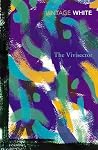
 The Vivisector
 by
Patrick White
My rating:
5 of 5 stars
I would have given this book ten stars out of five if possible but then I wouldn't have been able to write this.
This book is mainly about creative process (if you can can call it a process) of a forever perplexed painter, Hurtle Duffield/Courtney. Calling himself a freak, he is closer in touch with reality than most. Indifferent to this world and its affairs, his loyalty lies only with his paintings. In painting, he has found solace, an escape from the shallowness and purposelessness of this world and its bland reality. His whole life is just a flowing subject for his artistic expression which includes everything; even his closest relations. Its just his way of surviving which he will never be sure is the right one.
"It was Sunday, and Mamma had gone next door with Lena and the little ones. Under the pepper tree in the yard Pa was sorting, counting, the empty bottles he would sell back : the bottles going clink clink as Pa stuck them on the stack." The magical poetry in prose starts from the very beginning, the same magical "epic and psychological narrative.." for which Patrick White was awarded
Nobel Prize in 1973. His
interview after winning the award is quite interesting. A sort of curmudgeon, who on the day of announcement took a sleeping pill, went to sleep, while the press kept irritating him by "pastoring at his door", because he has had a very long tiring day.
The story begins with protagonist's childhood in an impoverished yet lively household. His father is an eccentric fellow who probably had an influence on the sensitive son. His household is changed somehow and Hurtle finds himself in a lavish place with an affectionate mother and humped sister, Rhoda. You feel a similarity with Great Expectations but its different, you start to discover White's power of shifting perspectives and carving delightful sentences. In his second home, entranced by a chandelier, Hurtle discovers the one inside him which makes him "...at times jangle and want to explode into smithereens". Missing his previous home, he thinks:
"And suddenly something of the same fear got into him. He would have liked to find himself running with the mob of kids down Cox Street, away from everything to do with Courtneys'. In the street where he belonged. If he belonged. He didn't belong anywhere : that was what frightened; although he had wanted it that way"Time passes and he finds himself without a home and means; in the company of a peculiar prostitute, Nance Lightfoot. She takes a sudden sympathetic interest in this quaint personality and an uncanny relationship flourishes. He has been painting since childhood but now he starts his demented career with sponsorship and links provided by Nance. She introduces him to an art dealer, Caldicott. With the abrupt flight of artistic career, there is a creeping skepticism growing about his abilities to convey what he really experiences. The story gets interesting and quality of prose remains intact.
"(Nance)'What is it then? Explain to me. All this about modern art.'
(Hurtle)'If you could put it in words, I wouldn't have to paint.'""Occasionally he made drawings, little more than notes, which couldn't relieve his cynicism, nor his rage for physical exertion. He belched sour, and often wondered what had ever persuaded him he might become a painter."He departs from the life of city to live in a hilly hideout to continue his artistic pursuits. Living a shredded existence, irritated by ennui, eating bare minimum and cursing himself most of the time. By this you feel a similarity with Hunger by Knut Hamsun which persists with rest of the story. Nance visits him sometimes and their encounter is always interesting than before. Apart from outstanding stream of consciousness, White's mastery at building exceptional characters is magnificent. Especially the way they become victims of vivisection by the painter.
"She might have learnt it from Maman (the second one) herself, who rose like a genie of scent bottle, accusing him of faithfulness : to a class which had adopted him : to the education invested in him; to a love story not so very different, which smelled of melting chocolate and illicit brandy, instead of musty poundcake and whore's powder. Maman was sniffing, though.""Now he was appalled by his own dirty, horny feet. In the snapshot they look deformed. Or was it distorted? Just as you distort appearances to arrive at truth"While alive he never cared much about Caldicott and treated him with his artistic attitude, but later describing him to Cutbush (a character of another era (and reality)) he retains:
"'My friend Caldicott died a couple of years ago, after what they call 'a long illness' - in agony. In the last days of his vivisection he told me he had never held my unkindness against me, because he considered anybody in any way creative needs a source of irritation. He was happy to think he had provided me with just that.'"With Cutbush, the grocer he meets sitting somewhere on a remote place facing the river or sea, Hurtle concocts the ideas of The Grand Vivisector and Moon, they experience together in the sky, as a giant ass sitting on the swimming lovers in the flowing water. There's more to this vision and you realize how many boundaries White has crossed in this book. It was enough for his interlocutor: Cec Cutbush was forever intrigued by this bizarre artist, though he was far away from normal himself.
"(Hurtle)'I have been accused of loving myself. How could I? When I've always known too much about myself?'""Most of the day he now spent steadily painting, still destroying, but sometimes amazed at a detail which mightn't have been his, yet didn't seem to be anybody's else's. There were one or two canvases he had dared keep, in which dreams and facts had locked in an architecture which did not appear alterable."Finally he settles at Flint Street, a slummy area near the sea, where he drags his existence for rest of his life. In the dunny of the house bought from an old lady, he writes
" God the Vivisector
God the Artist
God the "
He hopes to complete the third line during his lifetime but he never did. I was really looking forwarded to that third line. In this house he plays with different variations presented by the light: of reality which he vivisects. Ultimately he achieves international fame but maintains his bohemian lifestyle. Boo Holingrake, a childhood encounter and now a rich widow, is one of his chief buyers. A period of dalliance between them and thanks to Boo, he meets Hero, a Greek woman, in a prearranged party. Its another turn in Hurtle's artistic career. He visits Greece for a supposedly transcendental and healing expedition which it never turns out to be.
Throughout the book, White never fails to surprise you with his strikingly subtle humor. His last consequential encounter is with Kathy, a teenager from his area striving to be musician. He imagines to conceive Kathy as a child inside himself but suffers abortion, though together they nourish the artist in each of them. Each episode of Hurtle's interaction with an important character can be a book in itself.
In the end, Hurtle's life is a sum of unwanted undirected obsessions, with living objects or otherwise, he experiences for the sake of his paintings. This book can be an axe for a suitable blow seeker. Makes you want to choose the road as Robert Frost propounds in his famous poem because some roads are doomed for destruction (it may have an aesthetic side). Its almost perfect how this whole story flows, with magical words and sentences. It was a thoroughly enjoyable journey for me.
"Almost everybody carries a hump, no always visible, and not always the same shape."Note: Brackets in the quotes are not part of quotes. Its a brief summary with what I thought added in between the lines
View all my reviews