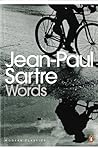
 Words
Words by
Jean-Paul Sartre
My rating:
5 of 5 stars
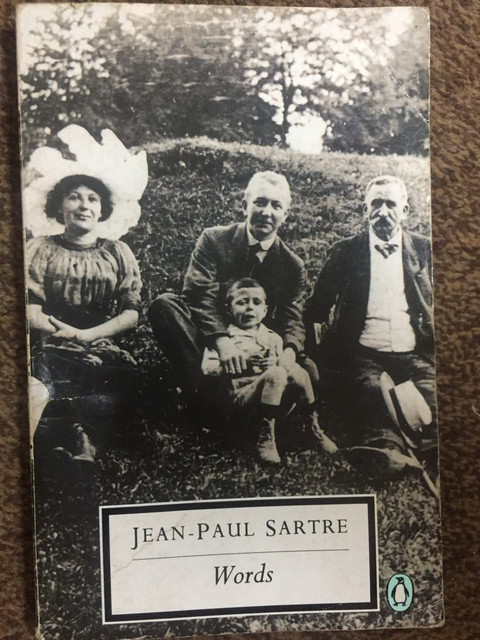 "I began my life as I shall no doubt end it: among books"
When Sartre died in 1980, 25,000 people attended his funeral. He is, and will be, widely read and discussed even today. He was awarded
Nobel Prize, for his work rich in ideas and filled with the spirit of freedom..., which he declined for noble reasons. His response can be read
here. During his childhood, around WWI, he used to imagine his life as writer, how he will be discovered, how well he will be received by the public, how much he will be adored and read. He had two hypothesis about being discovered before entering the limelight. In first hypothesis, he is discovered after his death and he will live through his work, each book carrying his consciousness. In second hypothesis, he is discovered by a mistake or chance without people actually knowing the writer but then suddenly one day a fine lady in a bar recognizes him. His both hypothesis turned out to be true if we ignore the dreamy details of lady etc. This book is Sartre's attempt to trace out from early childhood his beginning as a reader at first and then a writer.
"I was sought after! People were waiting for my works of which the first volume, in spite of zeal, did not appear until 1935. Round about 1930, people began to get impatient and to say to each other: 'He's taking his time! We've been feeding him for twenty-five years and he's done nothing! Shall we die without reading him?"
It is said that all fiction is autobiography; which makes all autobiography, fiction; it is hard to decide for me whether this is a work of fiction or non-fiction. Either way it doesn't really matter, Sartre's exciting, sublime, committed and cerebral writing style makes it a very interesting read. He never fails to cheer you up with every line, every paragraph. Especially his perspectives from different angles which surpass the spacetime of the setting and the boundaries of proportion.
"It was high time: I was going to discover the inanity of my dreams. In the course of my fantastic gallops, it was reality that I was seeking"
Sartre lost his father at an early age and lived with his maternal grandfather, Carl Schweitzer, a professor at Sarbonne. His father was a naval officer and had only left one instruction for his son, "My son will not join the Navy". Sartre had no one to restrict him in his childhood, he had nothing to claim or cling to. He was small in stature and cross-eyed, hence not accepted in the playground, he resorted to his apartment, specially the sixth floor of that apartment where he wrote, 'on the height where the dreams dwell'. Words saved him, his reading and writing were escapes from the world which had rejected him and he started building a world according to his dreams and fancies.
"In Sainte-Ann's Asylum, a sick man shouted from his bed: 'I'm a prince! Put the Grand Duke under arrest.' Someone went up to him and whispered: 'Wipe your nose!' and he wiped it; he was asked: 'Whats your trade?' and he replied softly: 'A shoemaker,' and started shouting again."
This book is divided into two parts, reading and writing, interesting for readers and writers respectively. Sartre shares his childhood and adolescence experience with books, how he came to be fascinated by them, absorbed in the world of dreams, imagining and living with the characters in the books he read. His favorites, at that time, were tales of chivalrous heroes featured in the magazines and bland literature. One man against all the odds with a happy ending. His grandfather was annoyed by his choice but he let Sartre go on with his little adventure. His grandfather wasn't happy with his writing adventures either, tried to stop him several times. But this, somehow, compelled Sartre to write even more. Sartre writes that later in life, he sometimes used to think that all his writing is just a try, to impress that old man, still sitting beside him.
"I think I should do better today and very much better tomorrow"
Sartre's experience with writing started as a reply to letters which his grandfather used to sent them, his mother, grandmother and himself, when they were spending summer holidays at Arcachon. For his first poetic reply, he got a poem as admiration in response. After the experience of some replies, he shifted to writing prose. He was given a notebook which he titled: "Novel Notebook" and the first story he completed was entitled 'For A Butterfly'.
"Mature writers do not feel like to be congratulated too enthusiastically on their earliest works: but I am sure that it is to me that such compliments give the least pleasure. My best book is the one I am busy writing; immediately after that comes the one most recently published, but I am getting ready, quietly, to loathe it soon afterwards."
Sartre wrote extensively and furiously throughout his life, disliking whatever he wrote before and only liking what he was writing at that specific time. He claimed he felt a sickness if he didn't write. He wrote novels, plays, articles, essays, philosophy and biographies. In the last years of his life he tried writing a biography of Gustav Flaubert, namely 'A Family Idiot', in four volumes. First two volumes were above 2000 pages. The third volume of this biography was the last work Sartre ever wrote. His work on ethics remained unfinished.
View all my reviews
 Sifar Se Aik Tak: Cyberspace Ke Munshi Ki Sargazasht / صفر سے ایک تک: سائبرسپیس کے منشی کی سرگزشت by Mirza Athar Baig
 The Murder of History: A Critique of History Textbooks Used in Pakistan by K.K. Aziz
 The Plague by Albert Camus
 In Cold Blood by Truman Capote
 Home Boy by H.M. Naqvi